This guide covers the practical installation of Aluminum Flexible Composite Air Duct in ceiling voids, service risers, floor build-ups and wall chases. It follows the sequence a site team actually works in — set out, fix, connect, commission — and flags the mistakes that most often cost time on a second visit.
Confirm three things before any material reaches the ceiling: the design air flow for each branch, the finished level of the structure the unit or duct will be fixed to, and the position of every service it must cross. Most rework on ducting installations traces back to one of these three not being checked.
A duct system that leaks 15% of its air is not 15% less effective — it is a system that no longer delivers its design intent and cannot be balanced. Leakage at joints shows up as terminals that cannot reach their design flow no matter how the dampers are set, and as extract points that fail to clear moisture from wet rooms. Because the defect is inside a sealed void, it is usually discovered only when the building is occupied. Push-fit systems with correctly seated seals achieve far better air-tightness than taped joints, and the difference is measurable at commissioning.
The three material families used in ventilation ducting each have a clear best-fit application. HDPE is flexible, chemically inert, tolerant of movement and ideal for long concealed runs where the route is not straight. PVC is rigid, dimensionally stable and well suited to compact flat-duct runs in shallow floor or ceiling build-ups. Galvanised steel is the default for larger commercial systems where mechanical strength and fire performance govern the specification. Specifying across these families on one project is entirely practical provided the transitions are made with proper adapters rather than improvised.
Our plant runs scheduled production for Aluminum Flexible Composite Air Duct with typical lead times of 15 to 25 days for standard items and 25 to 40 days for custom tooling projects. We load mixed containers directly at the factory, which lets us combine several product lines from your ventilation schedule into one shipment and reduce freight cost per unit. Confirmed lead times are stated on the order acknowledgement, not estimated at enquiry.
A significant share of our output goes out under our customers' own brands. For OEM work we apply your labelling, packaging artwork and documentation to Aluminum Flexible Composite Air Duct produced to your specification. For ODM projects we can also develop the product itself against a performance brief — wall thickness, airflow characteristics, finish and fittings — and supply it exclusively in your market subject to an agreed minimum order quantity.
Mark the centre line of the run on the structure and note every change of direction. Keep bends as gentle as the void allows; a tight bend costs more pressure than several metres of straight duct.
Support the run at the intervals stated for the material, and always support either side of a joint so that the weight of the run is never carried by the connection itself.
For each unit: route the run, cut to length, deburr the cut end and push-fit the joint. Dry-fit first, then secure. Never use the connection to pull a misaligned run into position.
Walk the whole run before the ceiling closes. Check that every joint is fully seated and that insulation is continuous — the most frequent defect we see in returned site photographs is leaving the insulation layer cut back so far that a thermal bridge forms at the joint.
Balance the system only after all terminals are fitted, then record the measured flows. A commissioning record is increasingly requested by building control and by clients pursuing energy certification.
Typical requirements are a fine-tooth saw or the manufacturer's cutter for the duct material, a deburring tool, a tape measure, a spirit level, appropriate fixings for the substrate and sealing tape or mastic compatible with the product. Using the wrong tape is a common cause of joints opening after a heating season.
| Item | Specification |
|---|---|
| Available Sizes / Models | Ø75mm, Ø100mm, Ø110mm, Ø125mm, Ø150mm, Ø160mm, Ø200mm, Ø250mm |
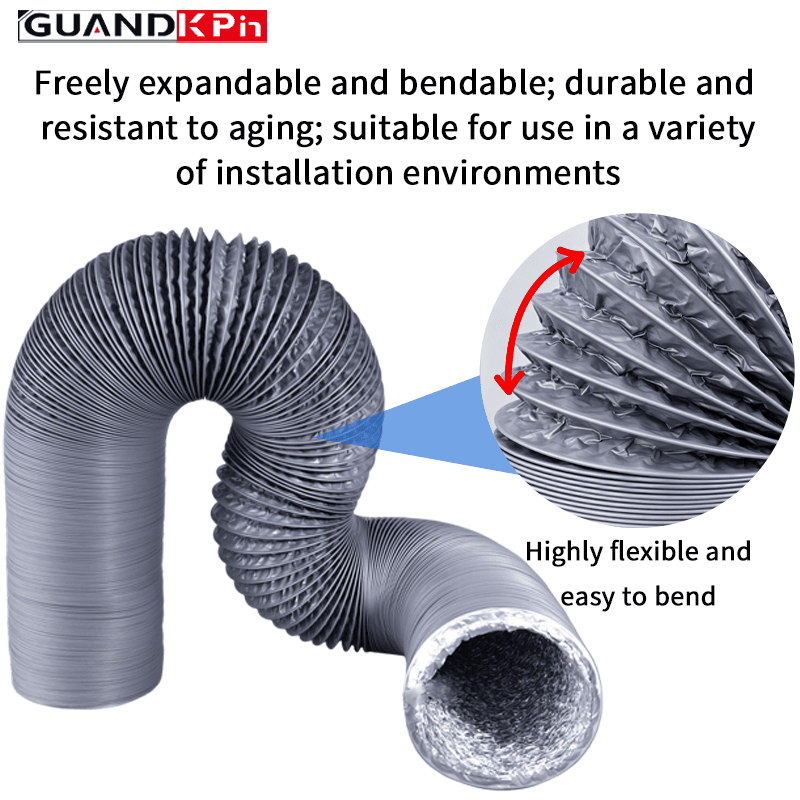
| Description | Flexible stretchable design, widely used for fresh air system, ventilation and exhaust system; Good flexibility for curved installation; Lightweight, easy cutting and mounting |
| Material / Construction | Aluminum foil composite film; Reinforcement: High tensile steel wire spiral support |
Clamp it onto fittings with our stainless steel hose clamps. For noise-sensitive end connections use the acoustic flexible transition connector; for insulated runs choose the insulated flexible duct.
GUANDE manufactures Aluminum Flexible Composite Air Duct at our factory in Dezhou, Shandong, China, and ships direct to HVAC contractors, distributors and project specifiers worldwide. Wholesale, OEM and ODM programmes are welcome. Send us the duct schedule or the drawing and we will confirm quantities, sizes and packing for the run.
The products below are routinely specified alongside the item discussed in this guide. GUANDE manufactures the full range in our own plant for consolidated shipping:
Q: Can it be used outdoors?
A: It is intended for indoor use. Exposed outdoor runs should be protected in a duct or casing.
Q: How is it fixed to ducts?
A: It slides over the spigot and is secured with a hose clamp — no glue or special tool required.
Q: Are insulated versions available?
A: Yes, see our insulated flexible duct range for anti-condensation applications.


The southeast corner of the private entrepreneurship park in Huadian Town, Qihui County, Dezhou City, Shandong Province