Perforated Plate Static‑pressure Terminal Vent For Fresh Air System needs very little attention once it is correctly installed — but the small amount it does need is what separates a system that still performs in year ten from one that has quietly lost half its design flow. This guide covers inspection, cleaning, fault-finding and the questions buyers ask most often.
Terminals are the visible face of the ventilation system, and they are judged on appearance as much as on performance. ABS and similar engineering polymers are the default choice because they hold their shape, resist discolouration and can be finished in a wide range of colours to match ceilings. Powder-coated steel is used where mechanical protection matters. For projects with specific interior requirements, colour matching and OEM branding are routinely available subject to minimum order quantities.
A system with more than three or four terminals will not balance itself. The branch with the lowest resistance will always take more than its share of the air, and the furthest terminal will always be short. Correct practice is to design the ductwork so that branch resistances are broadly comparable, then to use dampers for fine adjustment only. Systems that rely on dampers to correct a fundamentally unbalanced layout end up noisy, because throttling a branch to halve its flow increases the velocity noise at that terminal substantially.
A significant share of our output goes out under our customers' own brands. For OEM work we apply your labelling, packaging artwork and documentation to Perforated Plate Static‑pressure Terminal Vent For Fresh Air System produced to your specification. For ODM projects we can also develop the product itself against a performance brief — wall thickness, airflow characteristics, finish and fittings — and supply it exclusively in your market subject to an agreed minimum order quantity.
We supply Perforated Plate Static‑pressure Terminal Vent For Fresh Air System with the test reports, material certificates and inspection documents that your market requires, and we can arrange third-party inspection at the factory before shipment if your quality team or your customer requires it. Export documentation is handled in-house: commercial invoice, packing list, certificate of origin and the specific certificates your destination customs authority asks for.
| Interval | Action |
|---|---|
| Every 3 months | Inspect accessible terminals and inlets for dust build-up and obstruction. |
| Every 6 months | Check joints and supports along accessible runs; confirm nothing has sagged or separated. |
| Every 12 months | Clean or replace filters upstream; verify that the air terminals run is still airtight at every connection. |
| Every 24 months | Re-measure branch flows and rebalance if readings have drifted more than 10% from commissioning. |
Clean exterior surfaces with a damp cloth and a mild detergent. Do not use solvent-based cleaners, abrasives or pressure washers on insulated components — they damage the foil facing and the insulation behind it, and the resulting condensation damage is not covered by any warranty. Internal cleaning is normally limited to vacuuming the accessible end of a run; a correctly filtered system should not need duct cleaning as routine work.
In order of likelihood: blocked filter, a duct that has become disconnected inside the void, a damper that has been closed and not re-opened, or a crushed section where a later trade has stood on the run.
Almost always a cold-bridge at a joint where the insulation is discontinuous. The repair is to reinstate the insulation continuously, not to increase the heating.
Usually a support that has come loose, a component that has shifted against structure, or an increase in system pressure caused by a filter that has not been changed.
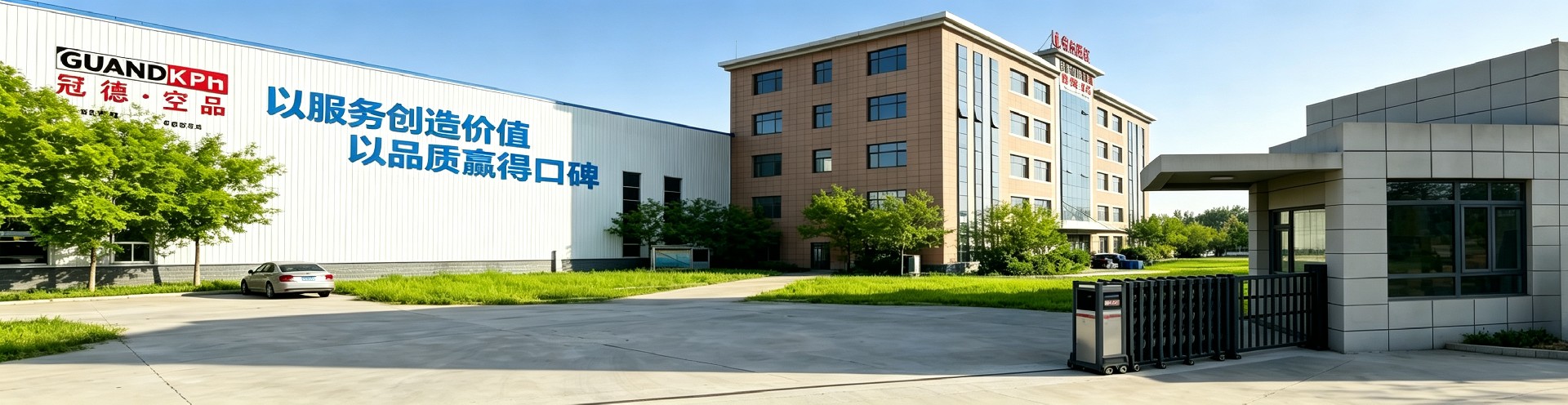
GUANDE manufactures Perforated Plate Static‑pressure Terminal Vent For Fresh Air System at our factory in Dezhou, Shandong, China, and ships direct to HVAC contractors, distributors and project specifiers worldwide. Wholesale, OEM and ODM programmes are welcome. Individual components can be reordered separately, which matters on a refurbishment where only part of a run is being replaced. Confirm the size and the profile system when reordering — a visually similar part from a different system will not seal against the existing run.
| Item | Specification |
|---|---|
| Available Sizes / Models | Static Pressure Terminal Vent |
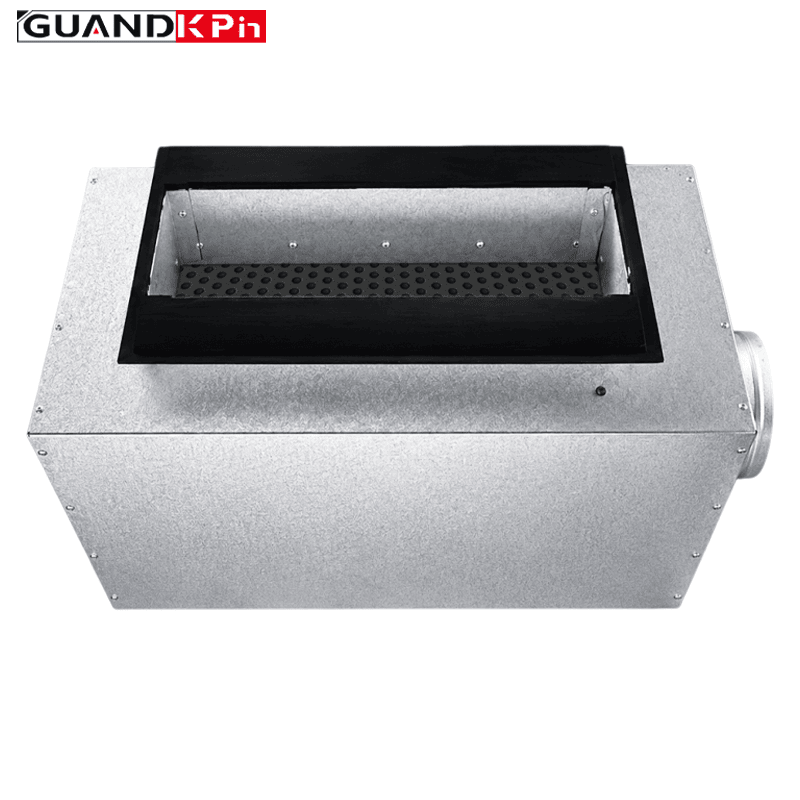
| Description | Customizable dimensions, round inlet port, internal perforated equalizing orifice plate, fits flat duct & circular ventilation duct |
| Material / Construction | Galvanized steel sheet metal |
Works with flat duct and HDPE circular duct systems. Also see our standard static-pressure terminal vent and floor supply terminal vent.
The products below are routinely specified alongside the item discussed in this guide. GUANDE manufactures the full range in our own plant for consolidated shipping:
Q: What does the perforated plate actually do?
A: It equalises the air velocity across the outlet face, so air is delivered evenly instead of as a concentrated jet.
Q: Can it be made to custom dimensions?
A: Yes, dimensions are customisable for the opening.
Q: Which duct sizes fit?
A: It accepts a round inlet matched to standard circular duct, and also suits flat duct systems.


The southeast corner of the private entrepreneurship park in Huadian Town, Qihui County, Dezhou City, Shandong Province